Developed a New Product Concept and Service for a Waste-to-Energy Startup

Developed a New Product Concept and Service for a Waste-to-Energy Startup

Developed a New Product Concept and Service for a Waste-to-Energy Startup

Cyrtan Energy, formerly known as Farm to Flame Energy, is a waste-to-energy company that utilizes its patented blue flame technology to convert organic waste into clean, usable energy. Their approach addresses both waste management and sustainable energy production at once.


Cyrtan Energy, formerly known as Farm to Flame Energy, is a waste-to-energy company that utilizes its patented blue flame technology to convert organic waste into clean, usable energy. Their approach addresses both waste management and sustainable energy production at once.


Cyrtan Energy, formerly known as Farm to Flame Energy, is a waste-to-energy company that utilizes its patented blue flame technology to convert organic waste into clean, usable energy. Their approach addresses both waste management and sustainable energy production at once.


ROLE

ROLE

ROLE

Product Strategist

Service Designer

Innovation Consultant

Product Strategist

Service Designer

Innovation Consultant

Product Strategist

Service Designer

Innovation Consultant

TEAM

TEAM

TEAM

CMU MIIPS Capstone Team (6 people group)

CMU MIIPS Capstone Team (6 people group)

CMU MIIPS Capstone Team (6 people group)

SKILLS

SKILLS

SKILLS

Service Design

User Research

Product Strategy

Innovation


Service Design

User Research

Product Strategy

Innovation


Service Design

User Research

Product Strategy

Innovation


Context

Context

Context

This project was completed as part of a Carnegie Mellon University capstone in collaboration with Cyrtan Energy. Working from a brief provided by Cyrtan Energy, our team applied the Integrated New Product Development (INPD) framework to research, define, and develop a human-centered solution that was ultimately pitched to Cyrtan Energy.


This project was completed as part of a Carnegie Mellon University capstone in collaboration with Cyrtan Energy. Working from a brief provided by Cyrtan Energy, our team applied the Integrated New Product Development (INPD) framework to research, define, and develop a human-centered solution that was ultimately pitched to Cyrtan Energy.


This project was completed as part of a Carnegie Mellon University capstone in collaboration with Cyrtan Energy. Working from a brief provided by Cyrtan Energy, our team applied the Integrated New Product Development (INPD) framework to research, define, and develop a human-centered solution that was ultimately pitched to Cyrtan Energy.


My Role

My Role

My Role

As part of a multidisciplinary innovation team, I conducted stakeholder interviews and research on industrial waste systems. I led service design work to develop the Recovery Hub concept for contaminated wood recovery.

As part of a multidisciplinary innovation team, I conducted stakeholder interviews and research on industrial waste systems. I led service design work to develop the Recovery Hub concept for contaminated wood recovery.

As part of a multidisciplinary innovation team, I conducted stakeholder interviews and research on industrial waste systems. I led service design work to develop the Recovery Hub concept for contaminated wood recovery.

The Team

The Team

The Team

The Challenge

The Challenge

The Challenge

How should Cyrtan Energy position itself: energy provider, waste partner or infrastructure company? What partnerships, pricing models, or go-to-market strategies could accelerate adoption?

How should Cyrtan Energy position itself: energy provider, waste partner or infrastructure company? What partnerships, pricing models, or go-to-market strategies could accelerate adoption?

How should Cyrtan Energy position itself: energy provider, waste partner or infrastructure company? What partnerships, pricing models, or go-to-market strategies could accelerate adoption?

Research

Waste or Energy?

Upon exploring the waste-to-energy space, one thing became very clear: waste is an expensive pain point due to high tipping and hauling fees. Businesses pay tipping fees to drop waste off at a facility, and hauling fees to have waste picked up and delivered to the facility. These fees are a guaranteed expense to waste generators.


Interviews with Cyrtan Energy's current customer base indicated that their main motivation for using Cyrtan's generator isn't energy generation, but waste cost savings.

As a result, our team recommends Cyrtan should focus on waste instead of energy, since waste is a guaranteed pain point and customers already find value in that side of the business.

As a result, our team recommends Cyrtan should focus on waste instead of energy, since waste is a guaranteed pain point and customers already find value in that side of the business.

As a result, our team recommends Cyrtan should focus on waste instead of energy, since waste is a guaranteed pain point and customers already find value in that side of the business.

Where can Cyrtan come In?

The Opportunity: Contaminated Wood.

While materials like paper and cardboard have clear recycling pathways, contaminated wood often does not. Clean wood can be recycled and repurposed, while contaminated wood goes to the landfill because removing contaminants requires additional time, effort, and cost.


Many industrial organizations are unwilling to take on this extra processing, making landfill disposal the easiest option. As a result, valuable wood waste is lost and organizations face high tipping and hauling fees for disposal.

Interviews with recyclers, waste haulers, and waste producers confirmed that contaminated wood is rejected at every point in the existing recycling stream, making landfill the only option

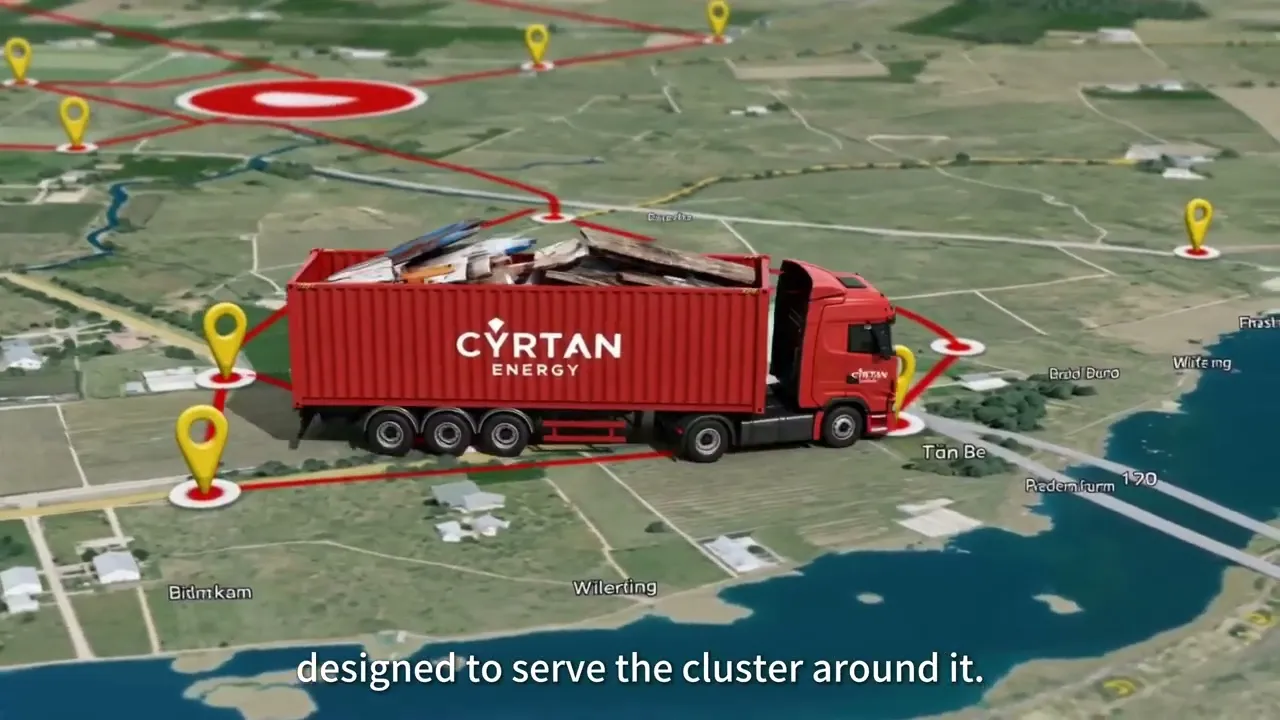
Through interviews in wood cluster regions, we found that most contaminated wood waste is generated by furniture finishers, making them Cyrtan's target customer.


Furniture finishers assemble, detail, stain, seal, and apply topcoats to wooden furniture.

Through interviews in wood cluster regions, we found that most contaminated wood waste is generated by furniture finishers, making them Cyrtan's target customer.


Furniture finishers assemble, detail, stain, seal, and apply topcoats to wooden furniture.

Through interviews in wood cluster regions, we found that most contaminated wood waste is generated by furniture finishers, making them Cyrtan's target customer.


Furniture finishers assemble, detail, stain, seal, and apply topcoats to wooden furniture.

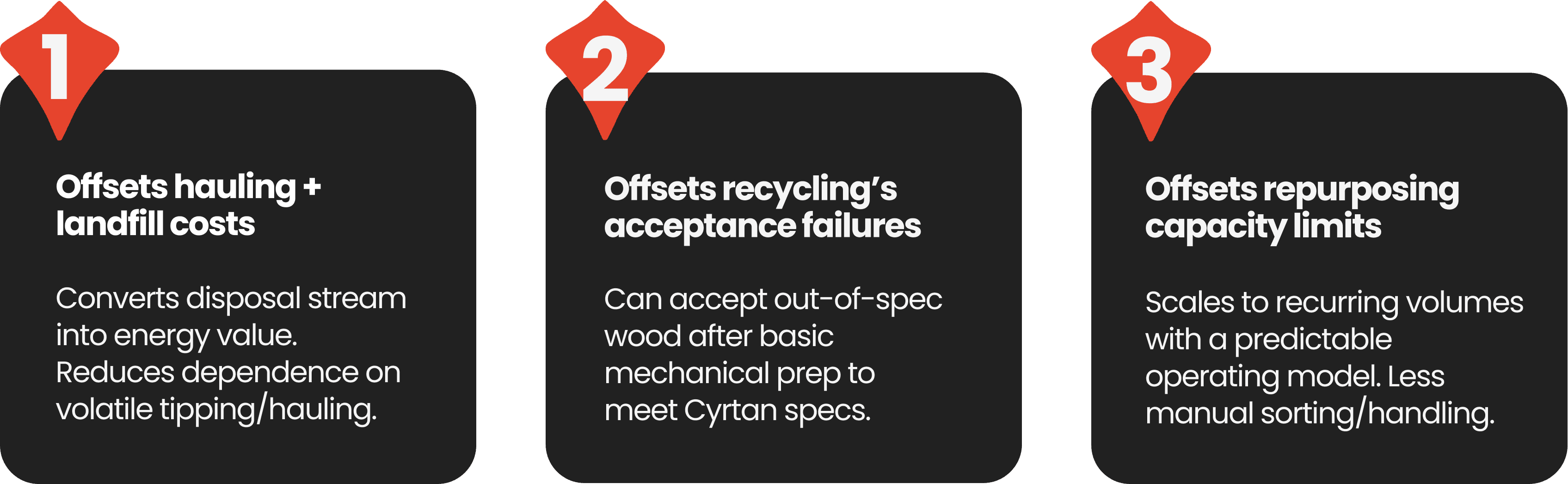
Cyrtan's Competitive Differentiation for Contaminated Wood

Cyrtan's Competitive Differentiation for Contaminated Wood

Cyrtan's Competitive Differentiation for Contaminated Wood

The Solution

Read Full Report

Cyrtan Recovery Hub

A centralized aggregation hub that collects non-recyclable wood waste from furniture finishers and converts it into usable energy.

Why a hub model?

Why a hub model?

Why a hub model?

Individual furniture finishers don't produce enough waste on their own, making a hub model the most viable way to aggregate feedstock

Individual furniture finishers don't produce enough waste on their own, making a hub model the most viable way to aggregate feedstock

Individual furniture finishers don't produce enough waste on their own, making a hub model the most viable way to aggregate feedstock

Hub Key Actors

Hub Key Actors

Hub Key Actors

The Value Exchange

The Value Exchange

The Value Exchange

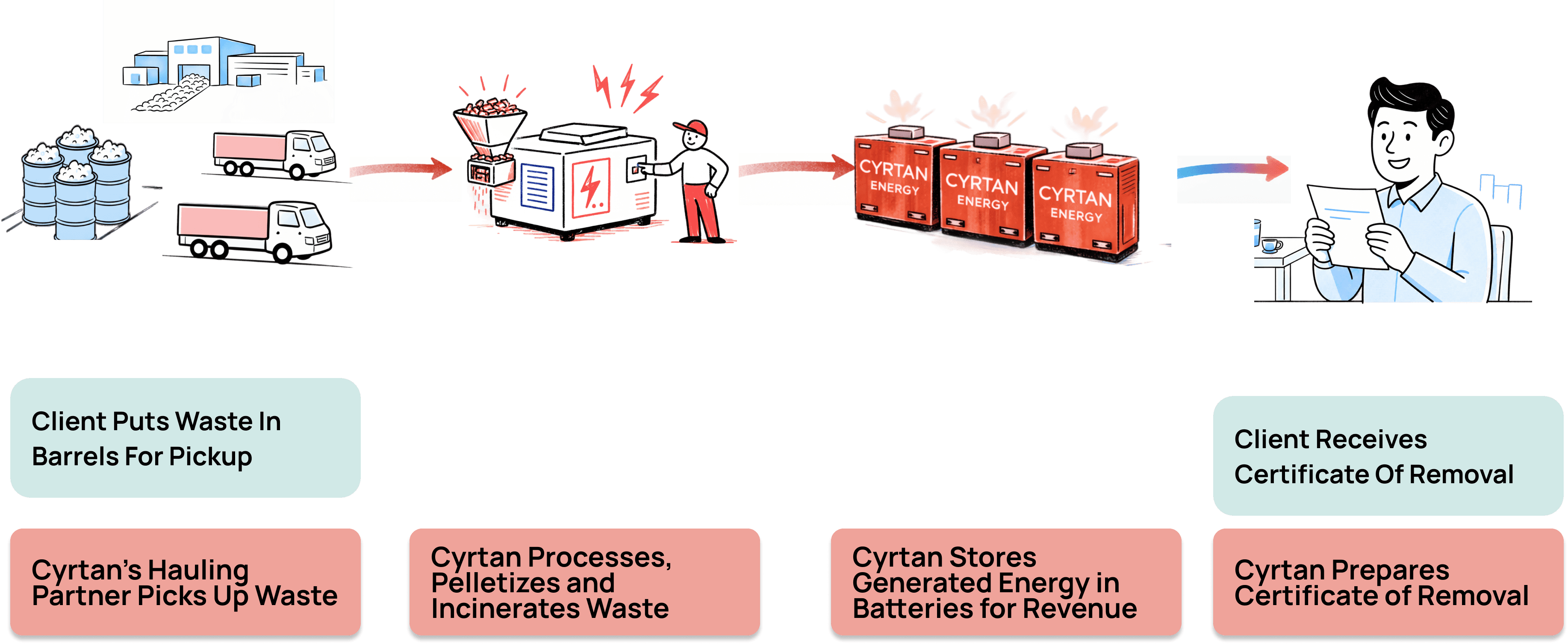
Hub Service Design

View Full Blueprint

Phase 1: Discovery & Partnership

Phase 2: Waste Removal
Site Layout

Validation

Where should Cyrtan Pilot the Hub?

Where should Cyrtan Pilot the Hub?

Where should Cyrtan Pilot the Hub?

Why?

Why?

Why?

  1. Concentration of at least 30 furniture finishers that Cyrtan can target within 20 mile radius


  1. Around $300 - $400 per ton in tipping and hauling fees


  1. Defined permitting pathways and industrial-zoned land enable fast, predictable deployment

  1. Concentration of at least 30 furniture finishers that Cyrtan can target within 20 mile radius


  1. Around $300 - $400 per ton in tipping and hauling fees


  1. Defined permitting pathways and industrial-zoned land enable fast, predictable deployment

  1. Concentration of at least 30 furniture finishers that Cyrtan can target within 20 mile radius


  1. Around $300 - $400 per ton in tipping and hauling fees


  1. Defined permitting pathways and industrial-zoned land enable fast, predictable deployment

Go-to-Market

Marketing & Brand Messaging

Marketing & Brand Messaging

Marketing & Brand Messaging

The pilot region has a large Amish population, making up the majority of furniture finishers in the area. This shaped the strategy. Digital outreach alone wouldn't reach the right people.
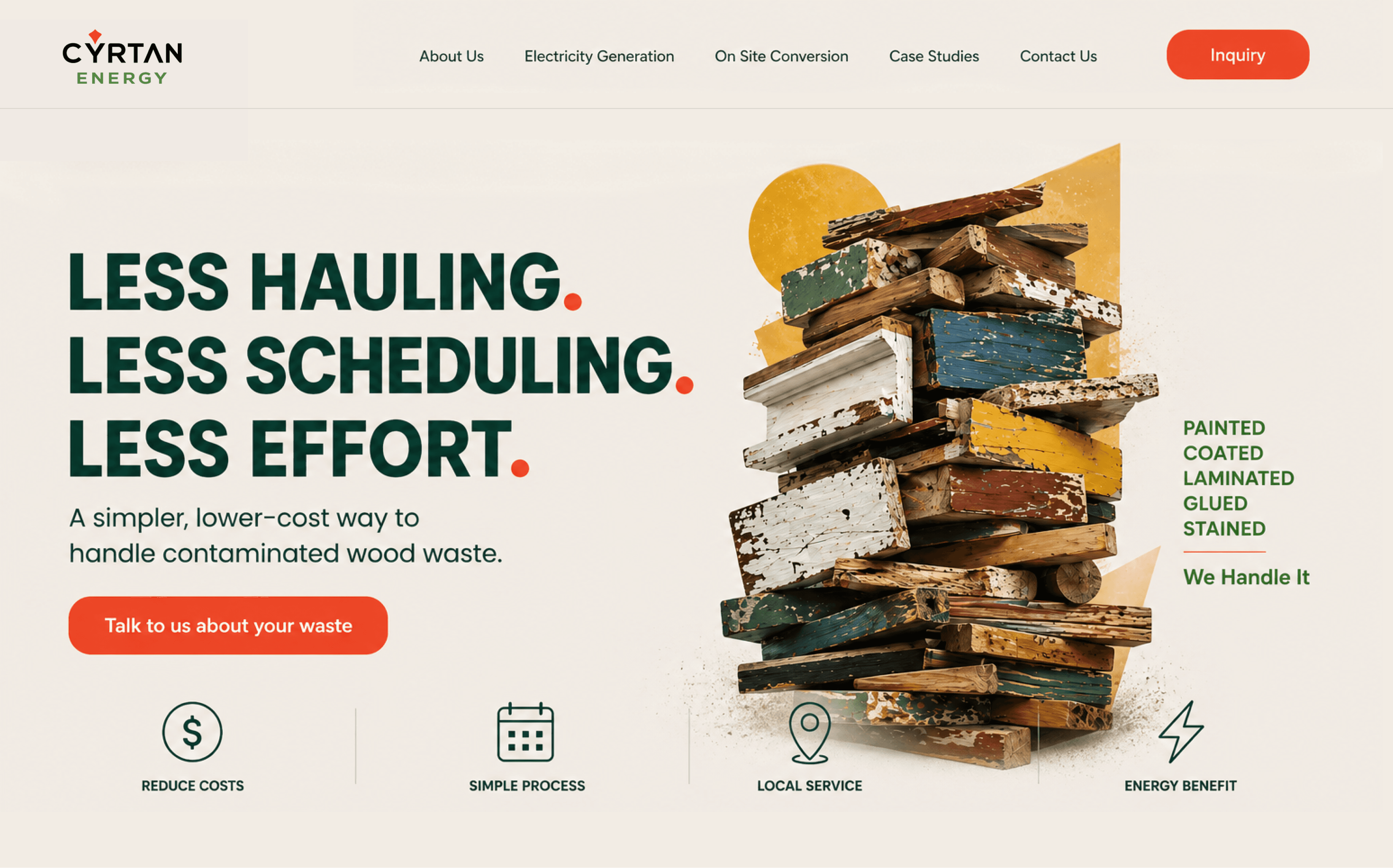
Cyrtan's Website redesign centered on waste cost savings and contaminated wood

Email promotion campaign emphasizing how contaminated wood waste removal with cyrtan would benefit their organization.

Direct outreach materials designed for the Amish community

Outcome

We presented the Cyrtan Recovery Hub concept directly to Cyrtan's CEO. His response went beyond interest. He'd already noticed competitors moving in a similar direction, which validated the strategy rather than raising doubt about it.

By the end of the meeting, he asked for contact info for the furniture finishers and stakeholders we'd interviewed, wanting to pursue the relationships himself.


We presented the Cyrtan Recovery Hub concept directly to Cyrtan's CEO. His response went beyond interest. He'd already noticed competitors moving in a similar direction, which validated the strategy rather than raising doubt about it.

By the end of the meeting, he asked for contact info for the furniture finishers and stakeholders we'd interviewed, wanting to pursue the relationships himself.


We presented the Cyrtan Recovery Hub concept directly to Cyrtan's CEO. His response went beyond interest. He'd already noticed competitors moving in a similar direction, which validated the strategy rather than raising doubt about it.

By the end of the meeting, he asked for contact info for the furniture finishers and stakeholders we'd interviewed, wanting to pursue the relationships himself.


Processes & Tools

Processes & Tools

This project followed the Integrated New Product Development (INPD) method, a structured process for turning opportunities into products. We began by identifying a genuine market need, then validated and refined concepts through the lenses of desirability, viability, and feasibility.

This project followed the Integrated New Product Development (INPD) method, a structured process for turning opportunities into products. We began by identifying a genuine market need, then validated and refined concepts through the lenses of desirability, viability, and feasibility.

AI

I used Claude and NotebookLM to gather and verify research before building on it and ChatGPT to generate visuals for storyboarding,


Research

60+ Stakeholder Interviews

PESTLE Analysis

Value Opportunity

Analysis

Strategy

Early Product Criteria

Financial Modeling

GTM Strategy

Value Exchange Model

Design

Service Blueprinting

Storyboarding

Pretotyping

Figma

Crazy 8's

Pretotyping

AI

AI

I used Claude and NotebookLM to gather and verify research before building on it and ChatGPT to generate visuals for storyboarding,


I used Claude and NotebookLM to gather and verify research before building on it and ChatGPT to generate visuals for storyboarding,


Research

Stakeholder Interviews

PESTLE Analysis

Value Opportunity

Analysis

Strategy

Early Product Criteria

Financial Modeling

GTM Strategy

Value Exchange Model

Design

Service Blueprinting

Storyboarding

Pretotyping

Figma

3D Modeling &
Printing

Crazy 8's

Research

60+ Stakeholder Interviews

PESTLE Analysis

Value Opportunity Analysis

Strategy

Early Product Criteria

Financial Modeling

GTM Strategy

Value Exchange Model

Design

Service Blueprinting

Storyboarding

Pretotyping

Figma

Crazy 8's

Pretotyping

Processes & Tools

This project followed the Integrated New Product Development (INPD) method, a structured process for turning opportunities into products. We began by identifying a genuine market need, then validated and refined concepts through the lenses of desirability, viability, and feasibility.

AI

I used Claude and NotebookLM to gather and verify research before building on it and ChatGPT to generate visuals for storyboarding,


Research

60+ Stakeholder

Interviews

PESTLE Analysis

Value Opportunity

Analysis

Strategy

Early Product Criteria

Financial Modeling

GTM Strategy

Value Exchange Model

Design

Service Blueprinting

Storyboarding

Pretotyping

Figma

Crazy 8's

Pretotyping

AI

I used Claude and NotebookLM to gather and verify research before building on it and ChatGPT to generate visuals for storyboarding,


Research

Stakeholder Interviews

PESTLE Analysis

Value Opportunity

Analysis

Strategy

Early Product Criteria

Financial Modeling

GTM Strategy

Value Exchange Model

Design

Service Blueprinting

Storyboarding

Pretotyping

Figma

3D Modeling &
Printing

Crazy 8's

Research

60+ Stakeholder Interviews

PESTLE Analysis

Value Opportunity Analysis

Strategy

Early Product Criteria

Financial Modeling

GTM Strategy

Value Exchange Model

Design

Service Blueprinting

Storyboarding

Pretotyping

Figma

Crazy 8's

Pretotyping

Learnings

Learnings

Learnings

1.

B2B opportunities require deep ecosystem understanding

The most valuable insights came from understanding how stakeholders actually manage waste today, allowing us to design a solution around their existing needs and challenges.

2.

Innovation starts with reframing the problem.

What began as a question about energy generation became an opportunity to solve a costly waste management problem.

What began as a question about energy generation became an opportunity to solve a costly waste management problem.

Build responsibly. Design with care.

Build responsibly. Design with care.

Build responsibly. Design with care.

Open to New Opportunities!